Palestine Monitor, Kara Newhouse, 30 June 2010
“There is a weapon more powerful than any Israeli tank or U.S. missile, which is international solidarity,” said Marcelo Buzetto, a São Paulo native visiting Haifa last month. The weeks following Israeli’s deadly flotilla raid on May 31st initiated an outpour of global support for the people of Gaza. As Israel deflects attention from ending the crushing blockade through its purported “easing,” people standing in true solidarity with Palestinians—including those in the West Bank, the 1948 areas, and the diaspora—should remember Buzetto’s words.
“There is a weapon more powerful than any Israeli tank or U.S. missile, which is international solidarity,” said Marcelo Buzetto, a São Paulo native visiting Haifa last month. The weeks following Israeli’s deadly flotilla raid on May 31st initiated an outpour of global support for the people of Gaza. As Israel deflects attention from ending the crushing blockade through its purported “easing,” people standing in true solidarity with Palestinians—including those in the West Bank, the 1948 areas, and the diaspora—should remember Buzetto’s words.
Buzetto and two other representatives of Brazil’s Landless Workers’ Movement (MST) conducted a ten-day tour to meet with participants of social movements throughout Palestine. They started their visit at the Second Haifa Conference for the Return of Refugees and the Democratic Secular State in Historic Palestine, where Palestine Monitor caught up with Buzetto to learn more about the connections between social movements in Brazil and Palestine.
“The MST is a movement of workers and farmers who fight for the land,” Buzetto stated. “The base of the MST is families who were expelled from their own land. They were obligated to leave and sell their labour for a very low price, and many families were expelled in a very violent way. Our struggle for the land connects us directly with the Palestinian people.”
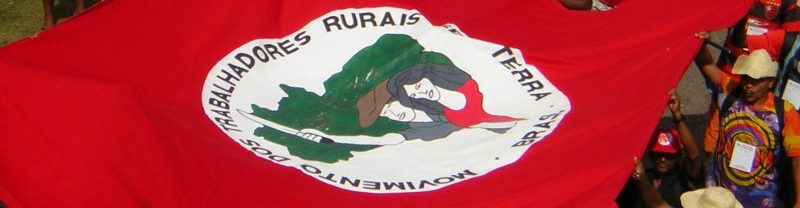
Marcelo Buzetto, MST delegate in Palestine, displays the flag of Brazil’s Landless Workers’ Movement while holding a falafel sandwich. According to Buzetto, Palestine and Brazil have more in common than their struggles for land and justice: “The base of the food is the same, and in Brazil, Arab food is very popular, so it contributes to the diversifying of Brazilian cuisine.”
Although Buzetto said that the MST sympathises with the idea of one state, he noted that Palestinians themselves are the ones who must determine the aims and trajectory of their struggle. He described the purpose of the MST’s delegation at the conference and in Palestine: “We are here to support the Palestinians in all that they decide will be the most urgent priorities—for example, the struggle for the refugees’ right to return, the struggle for the liberation of the political prisoners, the struggle to strengthen the boycott of Israeli goods around the world.”
According to Buzetto, Palestine solidarity committees exist in seven of Brazil’s 27 states. The MST aims to strengthen those committees and construct a national committee. In addition to MST members’ participation in solidarity marches, demonstrations, and the global boycott against Israeli products, an important solidarity campaign in Brazil is the struggle against the normalisation of trade relations with Israel.
Although Buzetto called all leftist parties pro-Palestine—including the Worker’s Party of the current president—in early March President Lula de Silva visited Jerusalem to give final approval to the Mercosur-Israel free trade agreement (FTA). The Mercosur trade bloc includes Brazil, Argentina, Paraguay, and Uruguay. The Israel FTA is the first free trade agreement to be signed by the bloc.
According to MercoPress, Brazil expects the trade agreement to raise bilateral trade with Israel to 3 million USD within five years. Brazil already imports products from many large Israeli companies, such as defense contractor Elbit systems and fertilizer producer Israel Chemicals. The country stands as Israel’s third largest export destination globally and its largest trading partner in Latin America.
When the Mercosur-Israel FTA negotiations first became public in 2006, “major Brazilian social movements in the city of São Paulo, and several political parties, joined forces to demand that the Brazilian government back out of and oppose the Mercosur-Israel FTA,” according to Arlene Clemesha, a Professor of Arab Culture at the Universtiy of São Paulo.
Clemesha wrote that these forces caused the postponement of the negotiations, but failed to build a sustained campaign against the FTA. Thus, the negotiating counties quietly signed the agreement a year and a half later. In January 2008 when young São Paulo activists created a new organisation called Mopat (“Palestine for All Movement”), they set as a primary objective the building of a campaign to prevent the FTA’s ratification. Members translated and distributed documents on the FTA from the Palestinian Grassroots Anti-Apartheid Wall Campaign (Stop the Wall) and the BDS National Committee.
Mopat then called a meeting among civil society organisations, trade unions—which are highly organised in Brazil and actively pro-Palestine—and representatives of the political party PSOL (“Socialism and Liberty”). MST members attended this meeting, during which participants initiated efforts to speak to political leaders and gather support from social movements calling the annulment of the FTA. The campaign faced challenges among some civil society leaders who wanted to simply “reform” the agreement to exclude tax exemptions for settlement products. According to Clemesha, “this is consistent with Brazilian foreign policy of ignoring the power imbalance” between Israel and Palestine.
The solidarity campaign celebrated a success in September 2009 when the Brazilian Parliamentary Commission on Foreign Relations and National Defense called for a freeze on the Mercosur-Israel FTA, as reported previously by Palestine Monitor (http://www.palestinemonitor.org/spi…). Nevertheless, Brazil’s Congress ratified the FTA later that fall, a decision that the Israeli Ministry of Foreign Affairs called “a consequence of President Peres’ visit to Brazil.” The Israeli Ministry also reported that Presidents Peres and Lula opened an economic conference together “in front of hundreds of Israeli and Brazilian business leaders” in March this year, just before President Lula gave his final approval to the agreement. The FTA entered into effect between Israel and Brazil in April.
Buzetto commented on the MST’s stance on these decisions by the Brazilian Congress and President: “We regard this as a grave error to sign an agreement with a government that is illegitimate, with a government and state that does not respect human rights and international humanitarian law—a colonising and racist state that persecutes and commits genocide against the Palestinian people, and also against the Israeli activists that fight for Palestinians’ rights to create their own state.”
The way forward for Brazilian activists and civil society leaders opposing the Israeli-Mercosur FTA is unclear, however Buzetto said that the MST is active in the coordinating of the first national meeting for solidarity with Palestine, which is likely to include discussion of this issue. They plan to hold this meeting during the week of November 29, the international day of solidarity with Palestine.
According to Buzetto, “No matter how combative or strong a society/people is, in order to defeat imperialism, it’s necessary for an international movement to exist.” He reiterated the connection between participants of social movements in his country and those in Palestine: “Palestinians are fighting for justice, democracy, social reform, as we also are doing in Brazil. We are not just fighting for the land, but to build a more just social reality.”