
Access to housing has, over the past decades, become one of the greatest problems for those of us living in the Spanish state. A dynamic that has only worsened since the 2008 crisis and the bursting of the housing bubble—an episode that, far from serving as a lesson for most, has been turned into an uncomfortable memory best hidden behind a thick veil.
Yet today, at a time when property prices have already surpassed their pre-bubble levels and rental prices are breaking every known record, it seems more necessary than ever to exercise our memory—not only to recall the last crisis, but to go further. We must ask ourselves when the place where we live (not merely survive) became a commodity. Only then can we understand why the media focus the housing problem on squatting rather than on the commodification of this basic need.
Private Property
The concept of property is deeply rooted in colonialism, patriarchy, and capitalism. These economic, political, and cultural systems appropriate land, resources, peoples, cultures, bodies, labor power, and the means of production. In recent decades, globalization has fostered industrial relocation in the Global North and extractivism in the Global South. In our current context, the ruling classes no longer extract as much profit from labor and resources at home, since these are exploited elsewhere. What sells now—what generates profit—is housing. That is why major business owners and investment funds have shifted their focus: they no longer invest in factories and industrial colonies, but in housing developments and residential buildings.
In the Global North, we must admit that the fall of the USSR and the counter-hegemonic power it exercised against neoliberal doctrine left us—plainly speaking—defenseless. The post–Cold War period, following in the footsteps of heavyweight conservative neoliberals such as Thatcher and Reagan, set a global agenda for the implementation and normalization of neoliberal discourse that has met no real obstacle since.
Neoliberal doctrine has been very skillfully implanted, precisely because it was not presented as an ideology. It has permeated every layer of social and cultural life, so that today we perpetuate many of its dynamics and behaviors without even realizing it. Our perception of housing has not escaped this logic.
Within the Spanish state, the ideal of a “nation of homeowners” was fiercely promoted first by the Franco dictatorship and has continued to be upheld by the post-1978 regime, regardless of which party has governed.
Neoliberal doctrine has gradually made its way forward, leaving behind a series of dogmas and mantras that now permeate everything, shaping today’s landscape through a mixture of concessions and blows.
On the one hand, we have been sold a naïve fantasy: meritocracy. The idea that if we strive hard enough and work tirelessly, we will achieve everything we desire. Beyond being false—because it ignores the structural conditions that largely determine each person’s or group’s possibilities (class, racialization, legal status, gender, and a long, unfortunate etcetera)—it is also a fallacy for other reasons.
Among them is the premise that merit and progress are purely individual matters, dependent solely on personal effort, ignoring that society is more than a sum of individuals—that we are bound by ties of interdependence that sustain and shape us. Moreover, the very end goal of this meritocracy is never questioned. It is taken for granted that everyone aspires to have more money, to buy more, to own more—in other words, that private property is the ultimate aim of meritocracy, equating well-being with purchasing power.
On the other hand, this American Dream–style ideal has also been nourished by a narrative of fear—of distrust toward the future, of the idea that no other system is possible, and that in the face of a terrifying future only individual action can save us. This “every man for himself” culture dismisses collective capacity to confront life’s challenges and scorns initiatives based on mutual aid as naïve, making collective solutions for emancipation ever more difficult to imagine.
Homeowners’ Corporatism vs. Class Solidarity
This trend, applied specifically to the so-called housing market, explains our current situation. Meritocracy and the “every man for himself” culture create the false belief that those who own property have earned it through sheer effort. Even among those who do not own property but aspire to someday (though they likely never will), a kind of homeowners’ corporatism emerges—one that sees any attack on private property, even someone else’s, as a threat, thinking: “One day that could be me.”
This homeowners’ corporatism breaks completely with any hint of class solidarity. Instead of identifying with the person who has nowhere to live, we see ourselves reflected in the large property owner, the wealthy individual, the banker, the YouTuber, or the celebrity—because that is what we aspire to become.
Under this logic, our perception of property has shifted entirely. The role of the landlord is no longer seen as that of a parasite, but as a legitimate option that everyone understands, justifies, and even strives to practice. We fully accept that financial institutions invest in real estate as a store of value. But it is not only banks, companies, and investment funds who do so. Today, it is perfectly normal to see public figures such as footballers—Cristiano Ronaldo, David Beckham, Andrés Iniesta, Lionel Messi—and singers—Rosalía, Manu Tenorio, David Bisbal, Aitana, Melendi—investing in property or even creating investment companies to purchase real estate and, why not, become a little richer.
And yet, socially, there is no explicit rejection of these practices—because perhaps, we think, one day it could be us. As a result, each of us, according to our means, tries to do the same.
We see it as entirely legitimate to buy a small flat to rent out and supplement our pension or salary; we consider it normal and positive to charge a friend for a room and earn extra income; we normalize the idea that the solution to today’s systemic precarity is an individual one, based on squeezing those who have less than we do. From there, it is only a small step to justifying evictions of people who cannot pay rent or mortgages, the clearing out of squats, or the hiring of thugs.
In this way, we become yet another link in this model, reproducing a dynamic that ultimately deepens our own misery. Instead of defending housing as a basic need that should be guaranteed to everyone; instead of imagining different systems that could make this possible; instead of pointing to the precariousness of wages and pensions; instead of organizing and fighting for a fairer model—we become cogs in the same system that squeezes us, destroying any possibility of class solidarity.
But we are not Rosalía. We are working class, and we know who stands beside us. That is why, instead of seeking individual escape and aspiring to enrich ourselves at others’ expense, we take to the street to stop our neighbor’s evictions and fight for dignified housing for all.
Squatting as a Political Tool
Why is squatting a tool of struggle that challenges the very foundations of private property? A squatted home in your neighborhood is one less house that will be turned into a tourist flat or a luxury rental. It is a brake on rising prices—not only of housing, but also of tomatoes in the supermarket and socks in the clothing store. It is also a proposal for a more communal way of living, one that breaks with the growing individualism surrounding us. It is a proposal for self-management and direct collective responsibility.
Squatting is an end in itself (by providing housing to someone who does not have it), but it is also a means—one of the most effective and direct ways to fight against private property and the neoliberal model of life.
Defending squatting means not only defending housing as a basic need, but also defending squatted spaces that have been central to political militancy among dissident movements. It is an act of resistance and a struggle for autonomy. The experience in Europe—where comrades in other territories have already witnessed and suffered the dynamics of evictions and the co-optation of squatted spaces by the state (a process that has led to the complete political annihilation of dissident and autonomous movements)—should put us on alert. In this way, their ability to organize from their own spaces has been made impossible, limiting political activity to state-granted spaces and therefore to initiatives tolerated by the state. This process should serve as a warning to territories such as the Spanish state and as an impetus to defend squatting even more firmly.
We can become so immersed in the logic of the capitalist (and increasingly individualistic) world that sometimes we forget the simplest ideas. As long as private property exists, as long as power dynamics exist, as long as simply living means having to pay, as long as we are exploited and repressed—struggle is essential. Squatting is and will continue to be a tool of denunciation and rebellion. It must remain not only a way to live with dignity, but a way to open spaces that escape market logic—spaces that propose other ways of relating, socializing, and making room for different struggles and for a culture alternative to the official one.
We have more than enough reasons to defend squatting. More than enough reasons to fight against capitalism, against exclusion, against racism, against power.
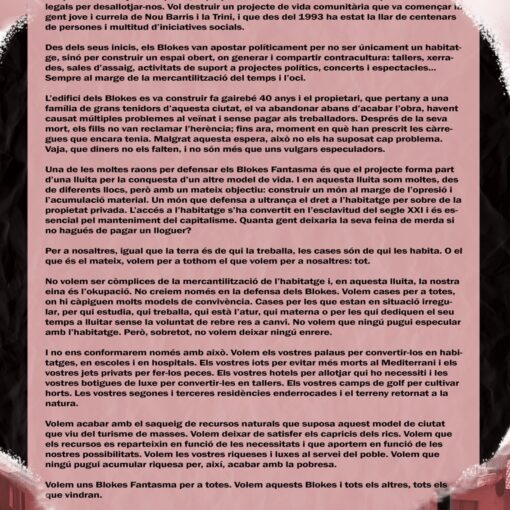
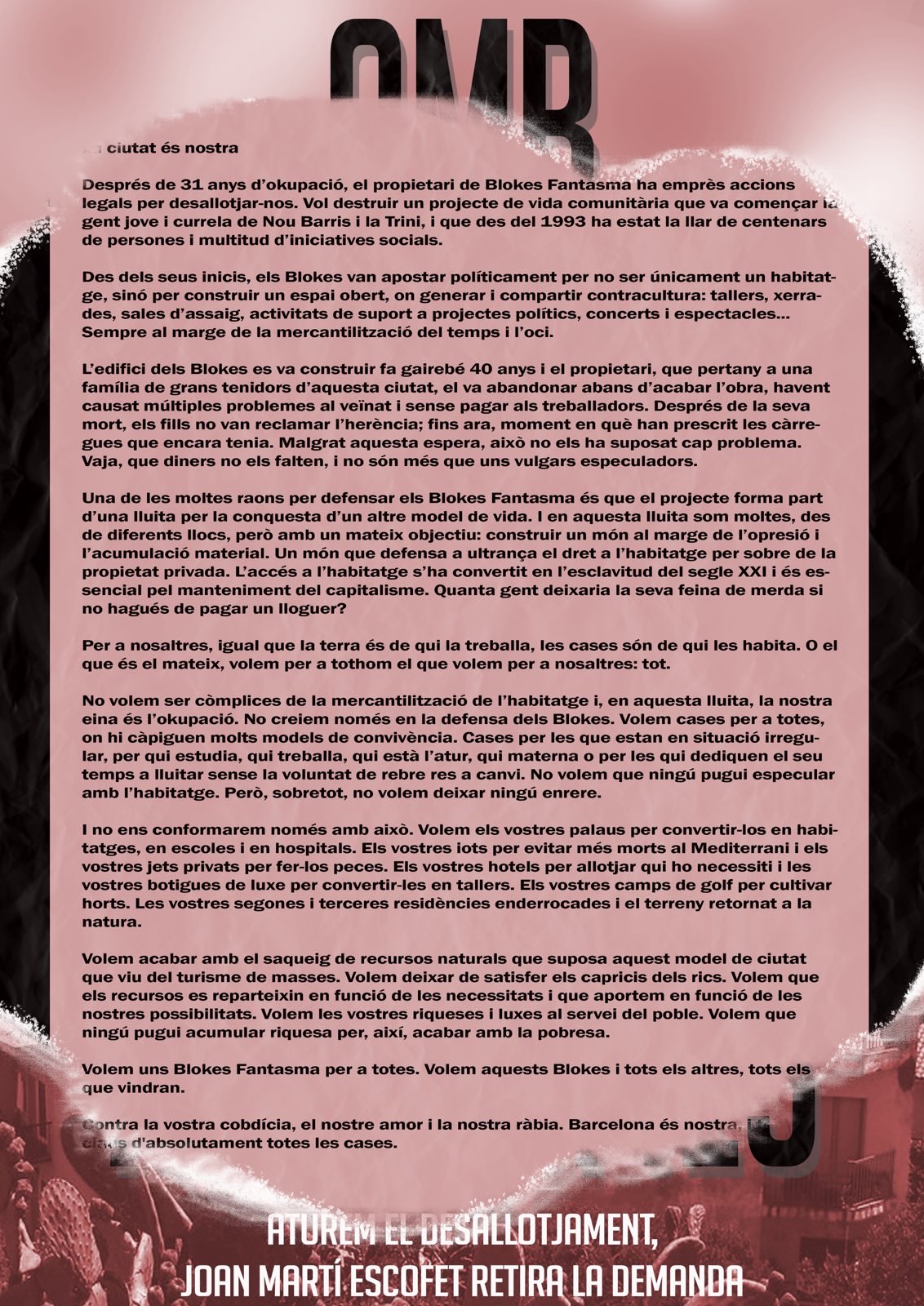
And so, louder than ever, we shout: “Amb Blokes no podreu, totes som fantasmes!