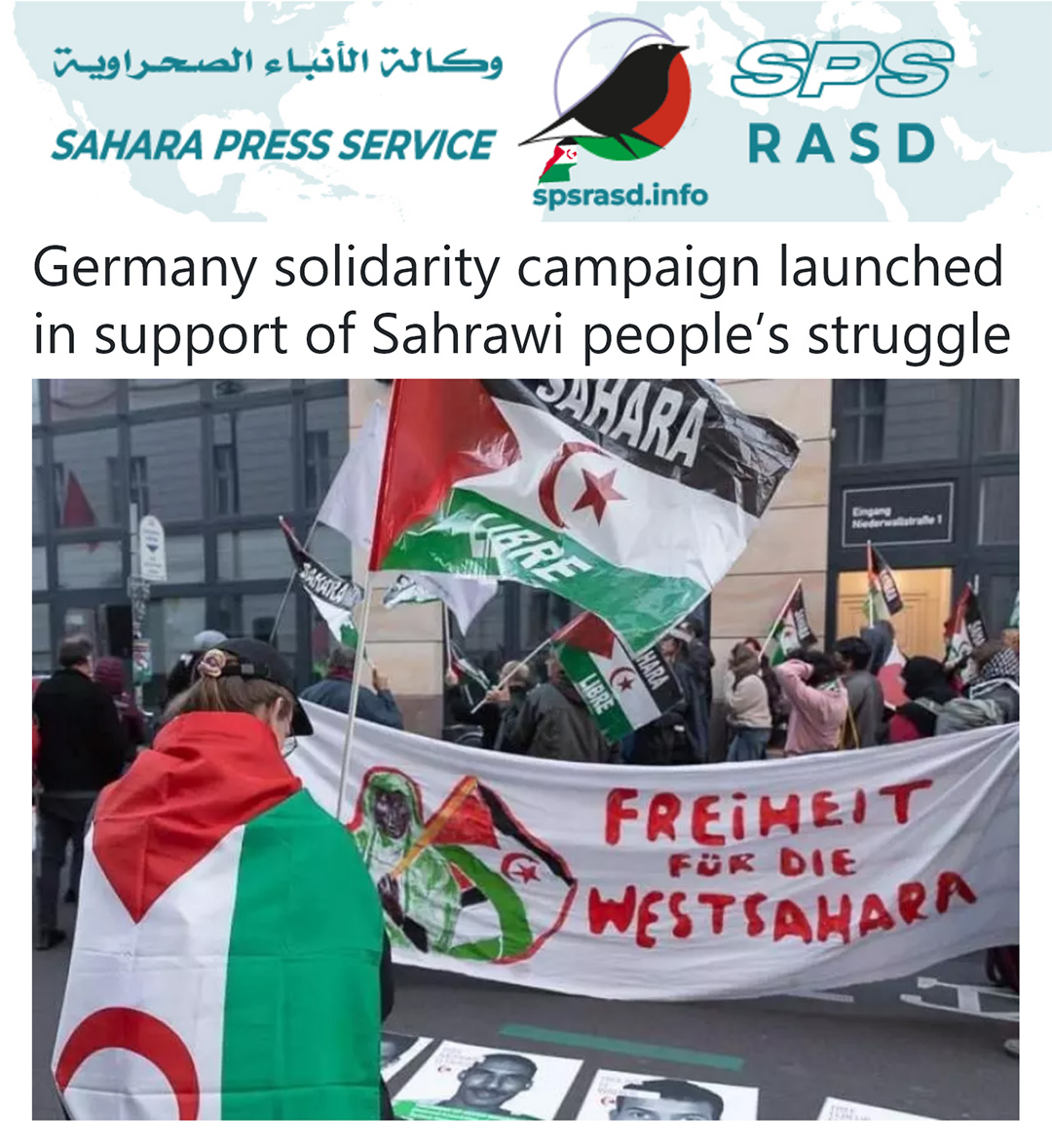
Berlin (Germany), 27 October 2026 (SPS) – The German solidarity movement with the Sahrawi people has launched nationwide solidarity weeks in support of their legitimate struggle for freedom and independence, marking the 51st anniversary of Morocco’s invasion of Western Sahara in 1975.
Running through the end of November, the campaign will feature nearly 30 political and cultural events across several German cities, including documentary screenings, debates, conferences, book readings, photo exhibitions and protests. The activities aim to raise public awareness of the Sahrawi people’s plight, including the situation in refugee camps, repression in the occupied territories, the exploitation of natural resources and Western Sahara’s legal status under international law.
In a statement, the movement denounced 51 years of Moroccan occupation, highlighting ongoing human rights violations, forced displacement and the illegal exploitation of the territory’s natural resources. It also criticised European governments for prioritising economic and geopolitical interests over international law and justice.
The statement reaffirmed the Sahrawi people’s determination to continue their struggle for freedom, democracy and justice, stressing that growing international solidarity strengthens their legitimate demand for self-determination and independence.
For his part, the Polisario Front Representative in Germany, Mohamed El Maamoun, welcomed the campaign, describing it as particularly significant amid ongoing discussions on the Sahrawi question at the UN Security Council.
He said the initiative provides an important platform to inform German public opinion about the Sahrawi position on the UN-led political process, which must be grounded in the UN Charter and the right of peoples to self-determination.
The Sahrawi representative also praised German solidarity organisations for their continued support for the Sahrawi people’s struggle and their efforts to expose human rights violations in the occupied territories and highlight the plight of Sahrawi political prisoners held in Moroccan prisons.
Ursprünglich veröffentlicht in PassBlue am October 23, 2026.
veröffentlicht:
Lesezeit:
7–10 minutes
Wörter:
1.601 words
The US has made radical proposals in its Security Council draft resolution on resolving the decades-long conflict in the Western Sahara, endorsing without ambiguity a Moroccan autonomy plan as the “only” option and prompting an immediate threat by the Polisario Front to quit the peace process if the resolution is passed.
The zero draft resolution was circulated to the 15 Council members on Oct. 22, only nine days before the expiry of the current 12-month mandate of the UN Mission for the Referendum in Western Sahara (MINURSO), which was created in 1991 as part of a ceasefire between Moroccan forces and Polisario. The short time frame for negotiations suggests pressure by the US for a decision by the Council to be made quickly to endorse the proposal, giving it a legal seal of approval, according to experts.
Among other aspects, Washington — the penholder on the issue — wants the name of the mission changed to erase the reference to a referendum, so it would be known as the UN Mission for a Political Solution in Western Sahara (MINUSO). The new name would signify a major political shift for the 35-year-old mission. ENTER YOUR EMAIL ADDRESS
The resolution, which would affirm that “genuine autonomy under Moroccan sovereignty is the only feasible solution to the question of Western Sahara,” would also place the UN’s imprimatur on Rabat’s control of the territory, which it invaded in 1975 when Spain withdrew as the colonial power. The US recognized Moroccan sovereignty in 2020, during President Trump’s first term.
The draft text would also end the UN’s peacekeeping mandate after six months, “and from 1 May 2027 the Mission shall continue as a special political mission until 31 October 2027.”
It also refers to the three rounds of US-led discussions that Morocco and Polisario, with neighbors Algeria and Mauritania, held in January and February on ending the conflict. The talks ended inconclusively, however, and may have been meant to give the appearance that efforts were made to find a solution among all parties.
Indeed, the new text says: “Morocco’s expanded and updated Autonomy Proposal . . . would be the only basis for continuing these discussions.” It “calls upon the parties to cooperate fully with the facilitators, to engage actively and constructively using Morocco’s Autonomy Proposal as the only basis for negotiation, and to put forward responses on the basis of the Autonomy Proposal.”
Polisario, which still demands that the original UN-agreed plan be carried out for a referendum among the Indigenous Sahrawi population of about 500,000, reacted with outrage to the zero draft.
“[It] is another extremely dangerous, unprecedented departure not only from the principles of international law underpinning Western Sahara as a question of decolonization, but also from the basis upon which the Security Council has addressed Western Sahara,” Sidi Omar, the Polisario ambassador to the UN, wrote in a letter to the monthly rotating president of the Council, Greece’s Aglaia Balta.
“It also contains elements that strike at the heart of the foundations of the UN peace process in Western Sahara and constitute a grave violation of the international status of the Territory.”
Council members have until Oct. 26 to comment on the text before a vote will be scheduled, possibly on Oct. 30.
Omar said the draft could not be the basis for deliberations on MINURSO or the peace process. “If the zero-draft were to pass without any substantive and meaningful changes, the Frente Polisario would have no choice but to disengage from the peace process as a whole.”
In remarks to PassBlue the day after the zero draft was circulated, Omar said: “It wasn’t that surprising to us, knowing that Morocco has sold out its soul to the US and others to get something in return, and they’re in a hurry to get it before US midterm elections.”
Return to war?
Analysts said the US proposals were a recipe for a return to conflict.
“This is a radical departure from a resolution-oriented path, which suggests the negotiations that the US succeeded in convening were in bad faith all along,” said Hannah Rae Armstrong, a policy adviser who specializes in North Africa and the Sahel region, referring to the talks earlier this year held in Madrid and Washington.
The four sides were brought together by Massad Boulos, Trump’s envoy to Africa; Mike Waltz, the US ambassador to the UN; and Staffan de Mistura, the personal envoy to Western Sahara of Secretary-General António Guterres.
“The zero draft immediately and sharply raises the risk of an escalation in the conflict,” Armstrong told PassBlue.
Erik Hagen, a board member of the Brussels-based Western Sahara Resource Watch, a nongovernmental organization, said that the current draft “is in violation of the UN Charter and is therefore an invalid resolution.”
“It’s in the DNA of the UN to try to prevent situations of aggression and occupation,” Hagen told PassBlue in a phone call. “That’s why we have the UN in the first place. What we’re seeing now is that we’re going towards a UN acceptance of occupation. This is bigger than Western Sahara, this has to do with the principles of international law. If it can happen here, why not in other occupations?”
Hagen said that imposing a solution under Moroccan sovereignty would not solve the conflict.
“The Sahrawis have rights to self-determination irrespective of what the Security Council decides. The Sahrawi people do not want to be Moroccan, they will keep opposing, they will still be prisoners in Moroccan jails, and they will still feel [alienated from] Morocco, a country that caused so much trauma for them.”
In a report to the Council on Oct. 1, Guterres stressed that Sahrawis had an “inalienable right to self-determination.” He added that “I wish to underscore that any proposal must be subject to a meaningful process of consultation with the people of Western Sahara, such that they have a free and voluntary choice to accept or reject it.”
The zero draft also cites the plight of the 170,000 refugees, about one-third of the Sahrawi population, who have been living in camps in the Tindouf desert region of Algeria after fleeing the Moroccan occupation. UNICEF has reported that nearly 11 percent of young children in the camps suffer malnutrition.
The draft notes “with deep concern the protracted nature of the displacement and the deteriorating humanitarian conditions in the Tindouf refugee camps, emphasizing that this situation cannot responsibly be sustained.”
The Tindouf camp
Waltz referred to Tindouf in a post on X after he met with Omar and other Polisario representatives at the end of September, held at the US mission to the UN, saying that the plight of the refugees was a reason for urgency. They “deserve real options, not another decade of waiting,” Waltz said.
In what appears to have been a response to US pressure on Tindouf, Polisario issued a statement on Oct. 14 saying “the protracted nature of the displacement or the difficulty of the situation” was being used as a pretext to force the refugees to move back to the Western Sahara with or without a settlement.
“Any proposals to organize a return process prior to the elimination of the root causes of displacement would amount to a reward for Moroccan occupation and a violation of the Geneva Convention regarding the protection of refugees,” said a document titled “The Legal and Humanitarian Situation of Sahrawi Refugees and Durable Solutions” that was submitted to the Council by the South African UN delegation on behalf of Polisario.
“The High Commissioner for Refugees must not . . . allow other parties, regardless of their influence or political agendas, to impose measures that disregard the free and sovereign will of the Sahrawi refugees or adopt a flawed approach that ignores the root causes of displacement,” the document said.
De Mistura warned Council members during closed consultations in early October that negotiations among the four sides involved had reached a stalemate.
“Although I remain convinced that a solution to this dispute is possible, I must now acknowledge that we have hit a wall in the negotiations,” de Mistura said, according to a transcript of his remarks seen by PassBlue. “I believe that . . . autonomy should be the basis for our next discussions.”
At the time, Omar condemned de Mistura’s remarks, saying in a statement that he had “seriously compromised his mandate of strict neutrality and his role as an impartial mediator by, inter alia, openly endorsing ‘autonomy’ as the basis for future discussions, thereby adopting a stance that aligns completely with the position of Morocco, the occupying state.”
Omar said that de Mistura’s approach raised “questions regarding his credibility, impartiality and independence as well as the viability of his mediatory mandate.”
In a call with PassBlue before the zero draft was circulated, the Polisario ambassador said: “MINURSO was established implement a very clear mandate, indicated in one of the letters of its name, ‘referendum.’ Morocco, of course, has a different position and is against a referendum. They know for sure they will lose it, the Sahrawi people will choose to be independent. That’s something of course they do not like, and unfortunately, they are being backed in this by the US and France, so they have no incentive to go forward for a genuine lasting solution.”
Omar added that the talks in January and February — the first time the foreign ministers of the four sides had all met in one room — had created momentum. “That process should be given time, and patience should reign; frankly, we are concerned about the views of those who think you can fix a conflict of over five decades in three or four rounds of talks. That short-cut kind of approach doesn’t work.”
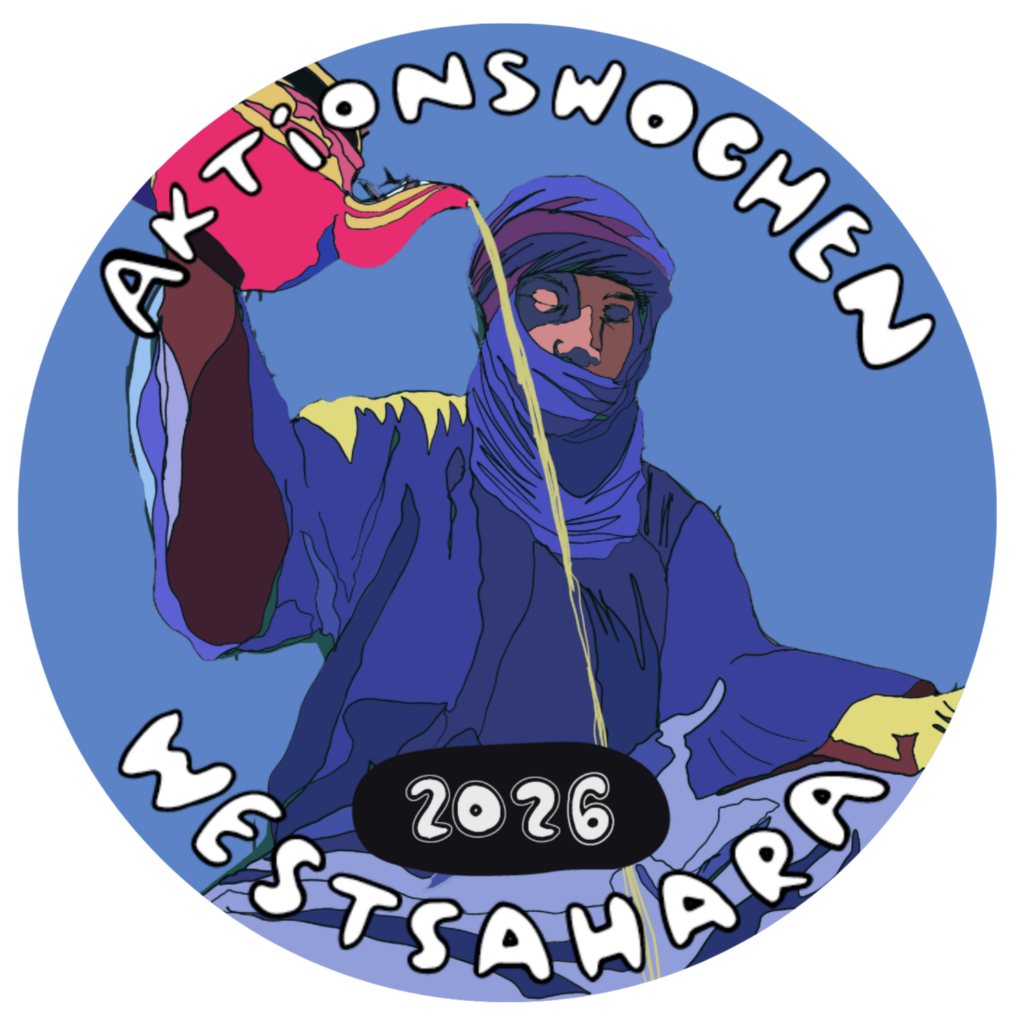
Bundesweite Aktionswochen Westsahara: „51 Jahre Besatzung – 51 Jahre Widerstand“ vom 31.10. bis 14.11.2026
WIR RUFEN AUF!
Als Netzwerk von Gruppen, Organisationen und Einzelpersonen aus verschiedenen politischen Zusammenhängen der Westsahara-Solidarität aus ganz Deutschland rufen wir dieses Jahr erneut zu bundesweiten Aktionswochen auf, um vereint auf die Besatzung der Westsahara und den Widerstand der Sahrauis aufmerksam zu machen.
Während Saharauis in den besetzten Gebieten weiterhin Repression erfahren und viele Menschen unter schwierigen Bedingungen in den Flüchtlingslagern leben, normalisieren internationale Regierungen und Unternehmen zunehmend die Besatzung und profitieren davon. Wir wollen diese weitgehend ignorierte koloniale Realität sichtbar machen und die internationale Solidarität stärken.
SEI DABEI!
Wir laden euch ein, euch im Rahmen der diesjährigen Aktionswochen über den saharauischen Unabhängigkeitskampf zu informieren, euch zu vernetzen und ein Ende der Besatzung zu fordern!
Beteiligt euch an den Aktionswochen! Organisiert eine Filmvorführung, eine Diskussionsveranstaltung oder ein kulturelles Event, verteilt Flyer und Plakate, veranstaltet eine Kundgebung oder entwickelt eure eigene kreative Aktion. Ob groß oder klein – jede Aktion kann dazu beitragen, auf die Situation in der Westsahara aufmerksam zu machen.
MACH MIT!
Kannst du bei dir selbst etwas organisieren, z.B. einen Filmabend? Willst du eine Veranstaltung, die schon geplant ist, unterstützen? Kontaktiere uns!
Auch wir als Solidaritätsbewegung für die Westsahara sind von der jüngsten Attacke der Trump-Regierung auf demokratische Infrastruktur weltweit betroffen: Wir bedauern sehr, dass das Kollektiv Autistici / Inventati nach 25-jährigem Bestehen, in dem es eine wichtige Säule für freien Austausch und Information im Internet war, zur Auflösung gezwungen wurde. Mit dem Betreiben von noblogs.org bot es Aktivist*innen die leicht zugängliche Möglichkeit, über ihr politisches Engagement zu informieren. Es leistete so einen wertvollen Beitrag dazu, antikapitalistischen und antifaschistischen Strömungen weltweit eine Stimme zu geben. Diese Stimme wurde erneut mit der stupiden Taktik, ihr einen “Terror”-Stempel aufzudrücken, zum Schweigen gebracht.
Auch unsere Webseiten muss nun kurze Zeit vor Beginn der Aktionswochen vom Netz gehen. Wir sind momentan auf der Suche nach Alternativen und halten euch auf allen Social Media Kanälen auf dem Laufenden, wenn wir eine neue Domain haben. Das wird nicht allzu lange dauern. Wir lassen uns nicht zum Schweigen bringen!
Antifaschismus ist kein Terrorismus!
English:
We, the solidarity movement for Western Sahara are among others affected by Trumps recent attacks on the world democratic infrastructure: We are deeply concerned that the Autistici / Inventati collective, after 25 years of existence during which it served as a vital pillar for free exchange and information on the Internet, was forced to dissolve. By operating noblogs.org, it offered activists an easily accessible way to share information about their political commitment. In this way, it made a valuable contribution to giving a voice to anti-capitalist and anti-fascist movements worldwide. This voice has once again been silenced by the stuporous tactic of labeling it as “terrorism.”
Our websites as well will go offline now, shortly before the beginning of the action weeks. We’re currently researching alternatives and will keep you updated on our social media channels once we have a new domain. It won’t take too long. We won’t be silenced!
Die sahrauischen politischen Gefangene haben in marokkanischen Gefängnissen erneut einen Hungerstreik begonnen und fordern ihre Freilassung, bessere Haftbedingungen sowie die Umsetzung von UN-Beschlüssen.
Ursprünglich veröffentlicht in WSRW am 06. Oktober 2026.
veröffentlicht:
Lesezeit:
3–4 minutes
Wörter:
597 words
Die sahrauischen politischen Gefangenen der Gdeim-Izik-Gruppe sind am 23. September in einen unbefristeten Hungerstreik getreten, um gegen ihre anhaltende Inhaftierung zu protestieren und die Umsetzung von Beschlüssen der UN-Menschenrechtsgremien zu fordern. Die Häftlinge fordern zudem eine Verlegung in Gefängnisse in der besetzten Westsahara, die näher bei ihren Familien liegen.
Der erneute Hungerstreik folgt auf die Aussetzung eines früheren Hungerstreiks des sahrauischen Menschenrechtsaktivisten Ennaama Asfari am 24. Juli. Nach Angaben des französischen Solidaritätsvereins AARASD, der sich für die Sahrauis einsetzt, nahmen die Gefangenen ihren Protest wieder auf, nachdem die marokkanische Gefängnisverwaltung ihre Zusagen, in einen Dialog zu treten, Verlegungen zu ermöglichen und das Besuchsrecht zu respektieren, nicht eingehalten hatte.
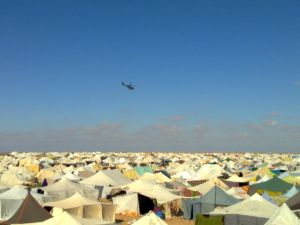
Die Gruppe von Gdeim Izik wurde nach der Räumung eines großen Protestlagers der Sahrauis vor El Aaiún am 8. November 2010 festgenommen. Tausende Sahrauis hatten sich in dem Lager versammelt, um gegen ihre sozioökonomische Marginalisierung, Arbeitslosigkeit und den Ausschluss von wirtschaftlichen Möglichkeiten in ihrer unter marokkanischer Besatzung stehenden Heimat zu protestieren. Die Demonstrant:innen prangerten zudem die Ausbeutung der natürlichen Ressourcen der Westsahara an, während die Sahrauis weiterhin marginalisiert blieben.
Das Lager, das sich auf bis zu 10.000 bis 20.000 Menschen vergrößerte, wurde zu einem Symbol für die Forderungen der Sahrauis nach sozialen und wirtschaftlichen Rechten. Marokkanische Sicherheitskräfte räumten das Camp im Rahmen einer gewaltsamen Operation; es folgten Festnahmen und Gerichtsverfahren, die zu Haftstrafen zwischen 20 Jahren und lebenslanger Haft führten.
In der Stellungnahme Nr. 23/2023 kam die UN-Arbeitsgruppe für willkürliche Inhaftierungen zu dem Schluss, dass die Inhaftierung der Gdeim-Izik-Gruppe willkürlich war, und verwies dabei auf schwerwiegende Verstöße gegen die Garantien für ein faires Verfahren, darunter die Verwendung von Geständnissen, die mutmaßlich unter Folter erzwungen wurden. Die Arbeitsgruppe forderte ihre sofortige Freilassung, Entschädigung sowie eine unabhängige Untersuchung.
Zu den Gefangenen gehört Sidahmed Lemjiyed, Generalsekretär des CSPRON (Sahrauisches Komitee zum Schutz der natürlichen Ressourcen) und Mitglied des Beirats von WSRW.
Am aktuellen Hungerstreik beteiligen sich Gefangene, die in den Gefängnissen von Kénitra, Tiflet und Aït Melloul in Marokko inhaftiert sind. Zu ihren Forderungen gehören ein Ende der mutmaßlichen Folter und Repressalien, eine unabhängige medizinische Überwachung sowie regelmäßiger Kontakt zu ihren Familien und Anwälten. Außerdem fordern sie die Verlegung in das Gefängnis im besetzten El Aaiún, da die langen Entfernungen zu den marokkanischen Gefängnissen ihrer Angehörigen erhebliche finanzielle, psychische und soziale Belastungen auferlegen. In der ursprünglichen Ankündigung des Hungerstreiks hieß es, dass neun Gefangene daran beteiligt seien. Nach Informationen von WSRW könnte die Zahl inzwischen auf sieben gesunken sein.
Am 1. Oktober besuchte das Kollektiv der sahrauischen Menschenrechtsverteidiger:innen in der Westsahara (CODESA) die Familien mehrerer Hungerstreikender. CODESA berichtete, dass die Familie von El-Bachir Khadda Bedenken hinsichtlich Isolation und Schikanen nach seiner Verlegung nach El Aaiún geäußert habe, während die Familie von Abdallah Bahaa angab, seit neun Tagen keinen Kontakt zu ihm gehabt zu haben. Auch die Mutter von Ahmed Sbaai berichtete von einer gravierenden Verschlechterung des Gesundheitszustands ihres Sohnes.
CODESA hat die marokkanischen Behörden aufgefordert, die Sicherheit der Gefangenen zu gewährleisten, eine unabhängige medizinische Versorgung sicherzustellen und den Kontakt zu ihren Familien und Anwälten zu ermöglichen. Die Organisation hat ihre Forderung nach der sofortigen und bedingungslosen Freilassung der Gdeim-Izik-Gruppe bekräftigt.
Der erneute Hungerstreik lenkt die Aufmerksamkeit erneut auf die sozioökonomischen Missstände, die 2010 erstmals Tausende von Sahrauis nach Gdeim Izik geführt hatten, sowie auf die anhaltenden Folgen für diejenigen, die nach den Protesten inhaftiert wurden.
In 2026 we will once again express our solidarity with the people of Western Sahara with Action Weeks from 31st of October to 14th of November. We invite you to join us and organize your own film screenings, information, discussion and cultural events, flyer and poster actions, rallies or other creative and powerful actions that address the situation and the struggle of the people in the occupied territories and in exile.
Western Sahara, the last African colony has been occupied by the Moroccan kingdom for 51 years.
While the majority of the original population has been violently expelled from their homeland and continues to be stuck in the Algerian desert under extremely harsh conditions, the Moroccan state claims to be the owner of their land and paints a delusive picture of Green Energy and luxury tourism. A picture cheerfully adopted by the Western Hemisphere, which continues to deny their responsibility to decolonize the area. Despite that it still officially carries the status of a “non self-governing territory”.
UNITED NATIONS CONTINUED FAILURE
For more than 30 years the UN didn’t accomplish the task to conduct a referendum, which should provide the opportunity for the original Sahrawi population to vote democratically about their future and their land. On the contrary, in October 2025 the UN Security Council resolution (2797) suggested “that genuine autonomy under Moroccan sovereignty could constitute a most feasiblesolution”, while at the same time ambiguously stating the Sahrawi’s right to self-determination. This resolution was based on an initiative by the US-government and its now closest ally in the Maghreb, Morocco. Most recently, Morocco interests are more and more being taken into consideration by global powers as it functions as a partner of military and economic cooperation. Meanwhile, not only the colonised Sahrawi people suffer from that development, but it’s to the detriment of the Moroccan people as well, as they lose valuable resources necessary for their own sustainment1 and even their sovereignty as there are new foreign military bases being built on Moroccan ground.
“AUTONOMY” PLAN PURSUES COLONIALISM
Meanwhile, the Moroccan so-called “autonomy plan” needs to be sharply criticised, as it’s just another term for entrenching the illegal colonisation and it is clear that it would under no circumstances ensure any autonomy regarding Sahrawi cultural freedom or human rights. During his first term as President of the United States, Donald Trump recognized Morocco’s claim over Western Sahara. In his second term, growing international support for Morocco’s autonomy plan from several Western governments has further strengthened its legitimacy and demonstrating the massive impact of US imperial policy.
Sadly, Western media and governments as well as the UN resolution mentioned above describe the autonomy plan as the “most practical,” “easiest,” and “most realistic” solution for the conflict. This approach denies any possibly democratic and just path for the region and is simply reaffirming the colonial situation, meaning: to maintain the illegal occupation is being presented as the “easiest” of all options.
SITUATION OF SAHRAWI PEOPLE
The Sahrawis who have been ousted from their country have been struggling to survive in makeshift camps for over five decades. While the Moroccan state is using and selling their resources, the Sahrawi are suffering under extreme heat and water scarcity or regular floods that endanger their existence. In March 2026 1500 families in Dakhla Camp were once more afflicted by a huge flood. The severe humanitarian situation is worsening because of climate change but also because of changes in world politics: The already malnourished refugees rely on international food programmes, which have been constantly cut down in recent years.
While the Sahrawis are drying out and suffer heavy health issues due to food deprivation, the Moroccan state invites tourists to the occupied Western Sahara to enjoy the beach and do kite surfing. While the Sahrawis withstand sandstorms that burst into their camps, the Moroccan state advertises itself as a pioneer of Wind energy in North Africa from the occupied Western Sahara. While the Sahrawis don’t have enough water to drink, the Moroccan state occupies their coast and exports their fish from the sea.
GERMANY IS ACTIVELY INVOLVED
The exploitation of Western Sahara wouldn’t be as profitable if Morocco wouldn’t be supported by numerous companies and enterprises who smell the money and in exchange ignore moral and judicial restraints. German companies among others keep being involved in this wheel of injustice: Siemens Energy supplied four out of five wind farms in the occupied territory until now and there are plans to further expand the cooperation. Hence the company is a willful supporting pillar for Morocco’s strategy of green-washing their colonial project. Heidelberg Materials operates two cement grinding plants and a ready-mix concrete plant in occupied Western Sahara. It does so by using its subcompany Ciments du Maroc. By providing concrete, the company is furthermore substantially supporting infrastructure for the occupation, for example for the construction of a new harbor in El Aaiún. Both Siemens Energy and Heidelberg Materials indicate to increase their involvement in Western Sahara. Fishmeal is being transported to Europe by Hamburg-based Köster Marine Proteins GmbH and the insurance company Allianz is not only continuously active in Western Sahara, but has also been prominently advertising the occupation by congratulating the Moroccan state for grabbing the territory. In the past ThyssenKrupp was involved in the phosphate mine of Bou Craa and the construction of the cement factory. Also DHL – which is affiliated with Deutsche Post – keeps being present in the area.
INTERNATIONAL SOLIDARITY
All of these connections denote colonial continuity. In the name of profit the Sahrawi population is being robbed of their land, the people oppressed and left to starve, while international corporations shake hands with the local oppressors. Supporting the Sahrawi struggle is part of taking a stance as an internationalist anticolonial movement. We salute the Sahrawi resistance in the camps and the occupied territory and express our revulsion of the racist normalisation of colonial violence. Every day Moroccan drones kill civilians and the public doesn’t take any notice of it. But if once there’s an act of resistance from the Sahrawi side, it is widely being condemned throughout media and institutions with a wagging finger. We oppose this hypocrisy and work to shed light into the widely unknown circumstances of this conflict.
We demand:
decolonise Western Sahara, reject autonomy plan, hand it over to the rightful owners and their representatives under no conditions.
acknowledge the Sahrawi Arab Democratic Republic and their structures.
boycott products, companies and tourism offers involved in or based on the occupation.
We look forward to see you at the Action Weeks! Message us if you want to organise an event, preferably until September 26.
For further information about Western Sahara, check out:
“6.4 percent of the population in Morocco (2,358 thousand people in 2021) ismultidimensionally poor while an additional 10.9 percent is classified as vulnerable to multidimensionalpoverty (4,028 thousand people in 2021).” Briefing note for countries on the 2023 Multidimensional Poverty Index, United Nations Development Program↩︎
En 2026 volveremos a expresar nuestra solidaridad con el pueblo del Sáhara Occidental mediante dos Semanas de Acción del 31 de octubre al 14 de noviembre. Te invitamos a participar y organizar tus propias proyecciones de películas, actividades informativas, debates y eventos culturales, acciones con folletos y carteles, concentraciones u otras acciones creativas y contundentes que aborden la situación actual y la lucha del pueblo saharaui en los territorios ocupados y en el exilio.
El Sáhara Occidental, la última colonia de África, lleva 51 años ocupado por el Reino de Marruecos.
Mientras la mayoría de la población originaria ha sido expulsada violentamente de su tierra natal y continúa atrapada en el desierto argelino, bajo condiciones extremadamente duras, el Estado marroquí afirma ser el propietario de esas tierras y proyecta una imagen engañosa de energía verde y turismo de lujo. Una imagen adoptada alegremente por el hemisferio occidental, que continúa negándose a asumir su responsabilidad de descolonizar la región. Todo ello a pesar de que el Sáhara Occidental mantiene oficialmente el estatus de «territorio no autónomo».
FRACASO CONTINUO DE LAS NACIONES UNIDAS
Durante más de 30 años, la ONU no ha logrado cumplir la tarea de organizar un referéndum que debería ofrecer a la población saharaui originaria la posibilidad de votar democráticamente sobre su futuro y sobre su territorio. Por el contrario, en octubre de 2025, la resolución 2797 del Consejo de Seguridad de la ONU sugirió que «una autonomía genuina bajo soberanía marroquí podría constituir la solución más viable», mientras afirmaba al mismo tiempo, de manera ambigua, el derecho del pueblo saharaui a la autodeterminación. Esta resolución se basó en una iniciativa del Gobierno estadounidense y de su actual aliado más cercano en el Magreb, Marruecos. Últimamente, los intereses de Marruecos están siendo tenidos cada vez más en cuenta por las potencias mundiales, ya que el país cumple la función de socio en materia de cooperación militar y económica. Mientras tanto, no solo el colonizado pueblo saharaui sufre las consecuencias de este desarrollo de los hechos, sino que también resulta perjudicial para el pueblo marroquí, que pierde recursos valiosos necesarios para su propia subsistencia1 e incluso parte de su soberanía, ya que se están construyendo nuevas bases militares extranjeras en territorio marroquí.
EL PLAN DE «AUTONOMÍA» PERPETÚA EL COLONIALISMO
Por otro lado, el llamado «plan de autonomía» marroquí debe ser objeto de una crítica contundente, ya que no es más que otra forma de afianzar la colonización ilegal. Está claro que, bajo ninguna circunstancia, garantizaría una verdadera autonomía con respecto a la libertad cultural saharaui o a los derechos humanos. Durante su primer mandato como presidente de Estados Unidos, Donald Trump reconoció la reivindicación de Marruecos sobre el Sáhara Occidental. Durante su segundo mandato, el creciente apoyo internacional al plan de autonomía de Marruecos por parte de varios gobiernos occidentales ha reforzado aún más su legitimidad y ha demostrado el enorme impacto de la política imperial estadounidense.
Lamentablemente, los medios de comunicación y los gobiernos occidentales, así como la resolución de la ONU mencionada anteriormente, describen el plan de autonomía como la solución «más práctica», «más sencilla» y «más realista» al conflicto. Este enfoque niega cualquier posible vía democrática y justa para la región y no hace más que reafirmar la situación colonial. En otras palabras: mantener la ocupación ilegal se presenta como la opción «más sencilla» de todas.
SITUACIÓN DEL PUEBLO SAHARAUI
Las personas saharauis expulsadas de su país llevan más de cinco décadas luchando por sobrevivir en campamentos improvisados. Por otro lado el Estado marroquí utiliza y comercializa sus recursos, la población saharaui sufre temperaturas extremas y escasez de agua, así como inundaciones periódicas que ponen en peligro su existencia. En marzo de 2026, 1.500 familias del campamento de Dajla volvieron a verse afectadas por una enorme inundación. La grave situación humanitaria está empeorando debido al cambio climático, pero también como consecuencia de los cambios en la política mundial. Las personas refugiadas, que ya sufren desnutrición, dependen de programas internacionales de ayuda alimentaria que han sido recortados constantemente durante los últimos años.
Mientras la población saharaui se deshidrata y sufre graves problemas de salud debido a la falta de alimentos, el Estado marroquí invita a turistas a visitar el Sáhara Occidental ocupado para disfrutar de sus playas y practicar kitesurf. Mientras la población saharaui soporta tormentas de arena que azotan sus campamentos, el Estado marroquí se promociona como pionero de la energía eólica en el norte de África gracias a instalaciones situadas en el Sáhara Occidental ocupado. Mientras la población saharaui no dispone de suficiente agua potable, el Estado marroquí ocupa sus costas y exporta el pescado procedente de sus aguas.
ALEMANIA ESTÁ ACTIVAMENTE IMPLICADA
La explotación del Sáhara Occidental no sería tan rentable si Marruecos no contara con el apoyo de numerosas empresas y corporaciones que buscan obtener beneficios y que, a cambio, ignoran las restricciones morales y jurídicas. Entre otras, empresas alemanas continúan involucradas en este ciclo de injusticia: Siemens Energy ha suministrado hasta ahora cuatro de los cinco parques eólicos existentes en el territorio ocupado y existen planes para ampliar aún más esta cooperación. Por tanto, la empresa constituye deliberadamente uno de los pilares de apoyo de la estrategia marroquí de greenwashing de su proyecto colonial. Heidelberg Materials opera dos plantas de producción de cemento y una planta de hormigón preparado en el Sáhara Occidental ocupado. Lo hace a través de su filial Ciments du Maroc. Al proporcionar hormigón, la empresa también apoya de manera sustancial las infraestructuras destinadas a la ocupación, por ejemplo, la construcción de un nuevo puerto en El Aaiún. Tanto Siemens Energy como Heidelberg Materials han indicado su intención de aumentar su participación en el Sáhara Occidental. Harina de pescado es transportada a Europa por la empresa con sede en Hamburgo Köster Marine Proteins GmbH, mientras que la compañía de seguros Allianz no solo continúa activa en el Sáhara Occidental, sino que también ha promocionado públicamente la ocupación al felicitar al Estado marroquí por apoderarse del territorio. En el pasado, ThyssenKrupp estuvo involucrada en la mina de fosfatos de Bou Craa y en la construcción de una fábrica de cemento. También DHL, vinculada a Deutsche Post, continúa presente en la región.
SOLIDARIDAD INTERNACIONAL
Todas estas conexiones representan una continuidad colonial. En nombre del beneficio económico, se está despojando al pueblo saharaui de sus tierras, se oprime a la población y se la deja pasar hambre, mientras las empresas internacionales estrechan la mano de quienes ejercen la opresión local. Apoyar la lucha saharaui implica tomar posición como movimiento internacionalista y anticolonial. Saludamos la resistencia saharaui en los campamentos y en los territorios ocupados y expresamos nuestro rechazo a la normalización racista de la violencia colonial. Cada día, los drones marroquíes matan a civiles y la opinión pública apenas presta atención. Pero cuando se produce un acto de resistencia por parte saharaui, este es ampliamente condenado por los medios de comunicación y las instituciones, que lo señalan con dedo acusador. Nos oponemos a esta hipocresía y trabajamos para arrojar luz sobre las circunstancias de este conflicto, que siguen siendo ampliamente desconocidas.
EXIGIMOS:
Descolonizar el Sáhara Occidental, rechazar el plan de autonomía y devolver el territorio a sus legítimos propietarios y a sus representantes, sin condiciones.
Reconocer a la República Árabe Saharaui Democrática y sus estructuras.
Boicotear los productos, empresas y ofertas turísticas implicados en la ocupación o basados en ella.
¡Esperamos verte durante las Semanas de Acción! Escríbenos si quieres organizar un evento, preferiblemente antes del 26 de septiembre.
Para obtener más información sobre el Sáhara Occidental, consulta:
«El 6,4 % de la población de Marruecos (2.358.000 personas en 2021) vive en situación de pobreza multidimensional, mientras que un 10,9 % adicional está clasificado como vulnerable a la pobreza multidimensional (4.028.000 personas en 2021)». Nota informativa sobre los países en el Índice de Pobreza Multidimensional 2023, Programa de las Naciones Unidas para el Desarrollo (PNUD) ↩︎
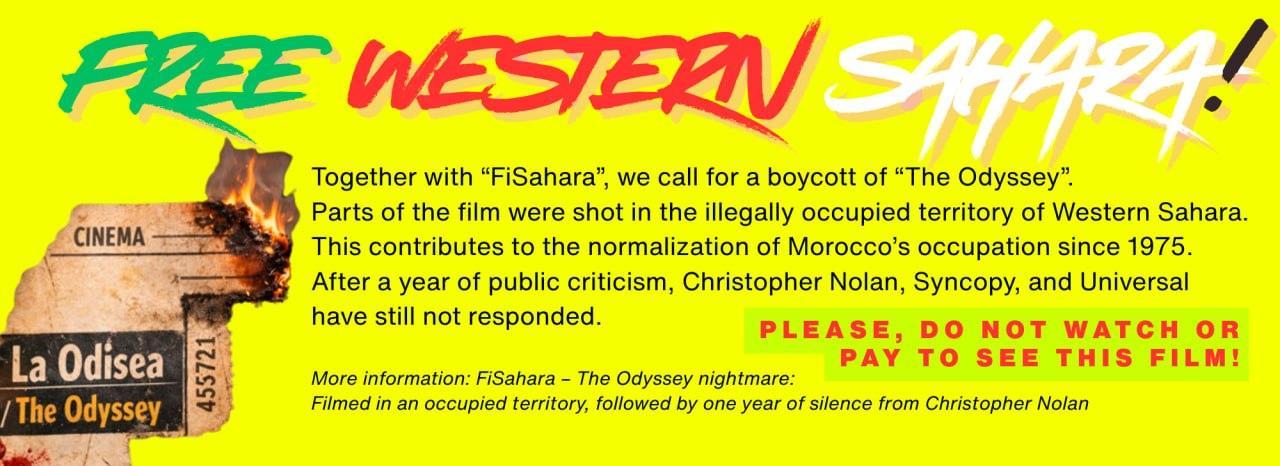
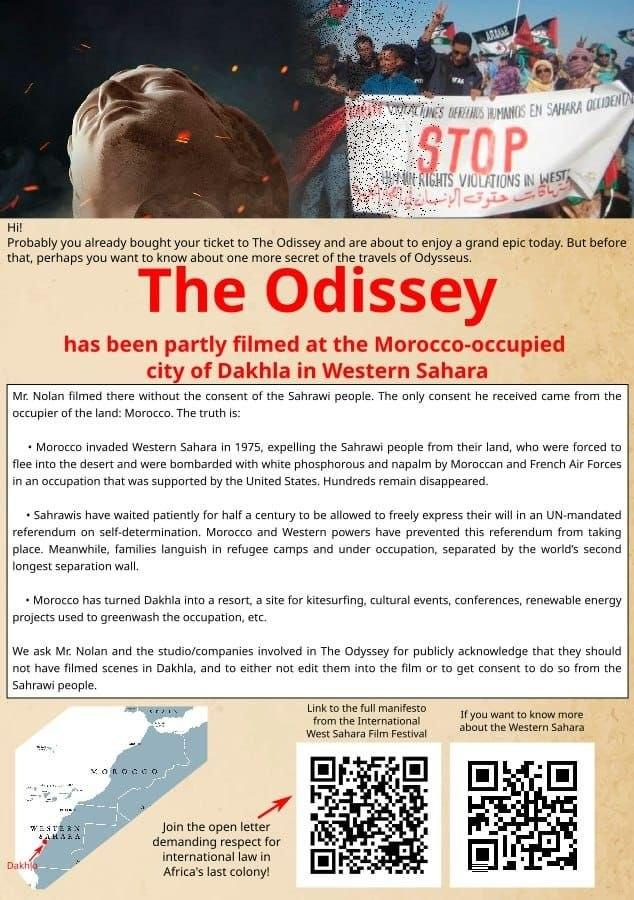
Als Unterstützung für den Boykottruf von Saharawis hat sich die Solidaritätsbewegung in Berlin vor Theatern präsentiert, die den Film zeigen, um die Besucher über die Misshandlungen des marokkanischen Staates zu informieren.
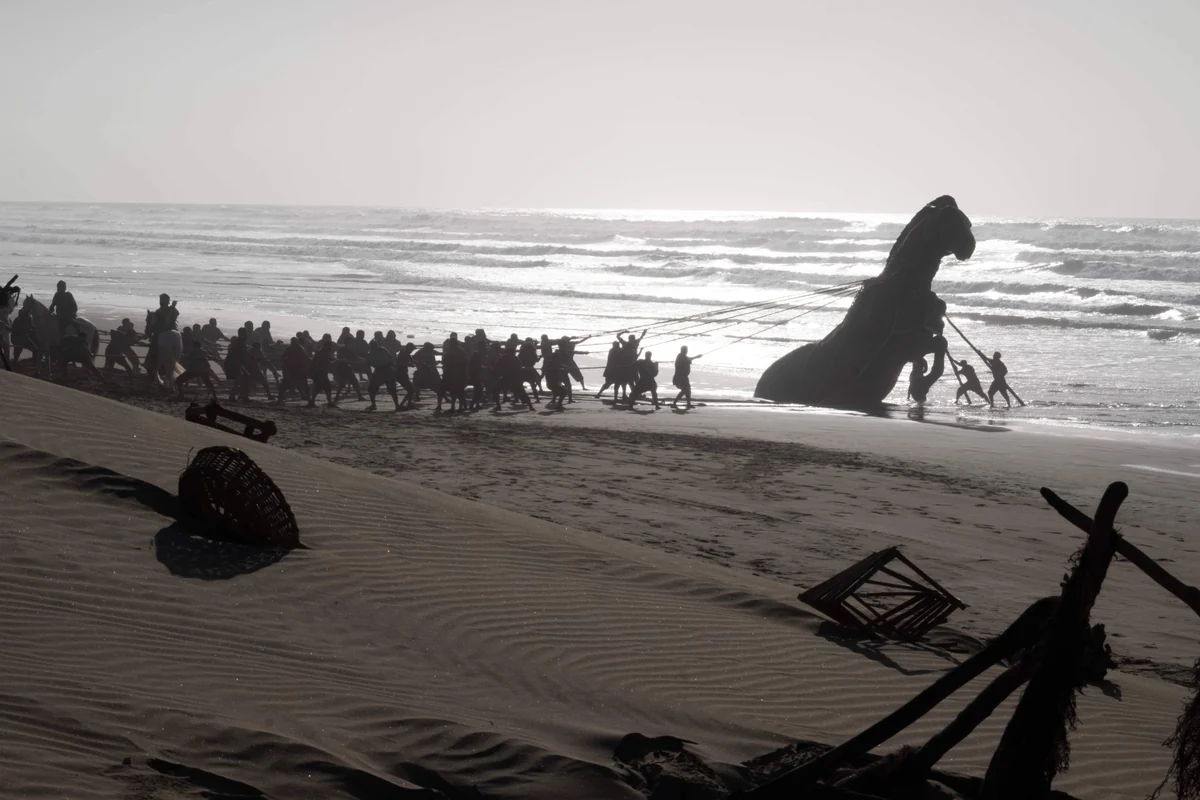
Christopher Nolans neuer Film wurde zum Teil in der besetzten Westsahara gedreht. Das scheint den genialen Filmemacher wenig zu interessieren.
Ursprünglich veröffentlicht in taz am 21. Juli 2026 – 07:09 CEST.
veröffentlicht:
Lesezeit:
3–4 minutes
Wörter:
592 words
Es gab kaum einen Weg vorbei an Christopher Nolans neuem Film „Die Odyssee“, der seit letztem Donnerstag in den Kinos läuft. Ein Marketing Budget von 125 Millionen US-Dollar und eine Starbesetzung mit Elliot Page, Matt Damon, Zendaya, Tom Holland, Anne Hathaway und Robert Pattinson schrie einem quasi ins Gesicht: Geh ins Kino!
In Vergessenheit geriet dabei die Debatte, die bereits letztes Jahr diskutiert wurde: Christopher Nolan drehte Teile seines Films in der völkerrechtswidrig besetzten Westsahara, einem Gebiet, das als „die letzte Kolonie Afrikas“ bezeichnet wird. Bis heute wird jegliche Äußerung oder Einordnung seitens Nolan vermisst.
Ziemlich genau vor einem Jahr rief das Sahara International Film Festival „FiSahara“ Christopher Nolan und den Cast dazu auf, die Dreharbeiten in Dakhla, einer Küstenstadt in Westsahara, zu stoppen. Bereits seit 1975 besetzt Marokko große Teile der Westsahara, direkt nach dem Abzug der Kolonialmacht Spanien.
Eigentlich hätte es damals ein Referendum geben sollen, bei dem die Bevölkerung über die Unabhängigkeit und Zukunft des Landes hätte abstimmen können. Das ist bis heute nicht passiert. Es folgte ein jahrzehntelanger bewaffneter Konflikt mit der Unabhängigkeitsbewegung Frente Polisario und die Vertreibung der indigenen Sahrauis.
Gutes Marketing für Marokko
Zu den Vertriebenen gehören auch die Macher:innen des „FiSahara“ Filmfestivals, die in ihrer Heimat keine Filme drehen können, sondern aus einem Flüchtlingslager im Südwesten Algeriens agieren. „Der einfache Akt, eine Kamera zu halten, kann in meinem Heimatland Westsahara ein Vergehen sein“, schreibt auch der Journalist Mohamed Sleiman Labat in einem Kommentar für den Guardian.
Denn wenn nicht Christopher Nolan die Kamera hält, sondern ein sahrauischer Filmemacher wie Labat, dann kann das im Gefängnis enden. Reporter ohne Grenzen bezeichnen deshalb die Westsahara auch als „Wüste für den Journalismus“.
Während Marokko also internationale Pressevertreter:innen und Menschenrechtsorganisationen die Einreise verweigert, stehen dem Tourismus inklusive Yoga-Retreats, Surfcamp und Luxusresort sowie der Filmbranche alle Türen offen. Eine Strategie, die von imperialistischen Staaten gern angewendet wird, um von territorialen Konflikten und Menschenrechtsverletzungen abzulenken und gleichzeitig die eigene Besatzung zu legitimieren. In anderen Worten: Gutes Marketing.
Die gelebte Odyssee der Sahrauis
Seit letztem Sommer fordert das Filmfestival deshalb von Nolan eine Solidarisierung mit den Sahrauis und das Aufklären über die Besatzung Marokkos. An dem Aufruf beteiligten sich zahlreiche Journalist:innen, Aktivist:innen und Filmemacher:innen. In den aktuellen Filmkritiken ist nur wenig davon zu hören.
Während Nolands Verfilmung von Homers Epos Themen wie Vertreibung, Familientrennung und den Kampf um die Rückkehr in die Heimat behandelt, grenzt es an Ironie, dass sich diese Parallelen in der real gelebten Odyssee der Sahrauis widerspiegeln. Dabei ist die Frage nicht, ob eine einflussreiche Person wie Christopher Nolan diesen kulturell aufgeladenen und komplexen Konflikt mit einem Statement hätte lösen können.
Es stellt vielmehr die Verantwortlichkeit weißer, reicher, privilegierter Menschen in den Mittelpunkt, die auch dann nicht handeln wollen, wenn ihnen die Fakten auf einem Silbertablett serviert werden. Selbst wenn das Rechercheteam der „Odyssee“ von dem Konflikt in der Westsahara vor den Dreharbeiten nichts wusste, hatten Nolan, Universal Pictures und auch die Schauspieler:innen ein Jahr lang Zeit, sich zu äußern.
Oder – wie „FiSahara“ forderte – die gedrehten Szenen auf besetztem Gebiet im finalen Schnitt nicht zu zeigen. Jemand wie Nolan, der sich damit brüstet, menschliche Konflikte und philosophische Fragen in seinen Filmen zu zentrieren, um damit gesellschaftliche Diskurse anzuregen, verkennt hier seine Chance, bei einem aktuellen Konflikt Stellung zu beziehen. Und das Publikum feiert ihn weiterhin als genialen Filmemacher. Denn er hat doch als erster einen ganzen Blockbuster auf der analogen IMAX-70-mm-Filmkamera gedreht.